Review and Key Quotes from “Humility” by Andrew Murray

Humility is a classic, must-read book for every Christian.

No other book I know of does a better job of explaining the utter importance of humility. Andrew Murray defines humility by pointing to Jesus. The following is a collection of the key quotes that stood out to me as I read. I encourage you to read these humbly and evaluate how you are doing in this important area.

 “His humility became our salvation. His salvation is our humility (17).”

“And so pride – loss of humility is the root of every sin and evil… it was when the serpent breathed the poison of his pride – the desire to be as God – into the hearts of our first parents, that they too fell from their high estate… pride or self-exhalation is the very gateway to hell (16).”

“Humility is the only soil in which virtue takes root; a lack of humility is the explanation of every defect and failure (17).”

“He teaches us where true humility begins and finds it’s strength – in the knowledge that it is God who works all in all, that our place is to yield to Him in perfect resignation and dependence (33).”

We are “nothing but a vessel, a channel through which the living God can manifest the riches of His wisdom, power, and goodness (34).”

“Humility is the only ladder to honor in God’s kingdom (38).”

“Just as water seeks and fills the lowest place, so the moment God finds the creature empty, His glory and power flow in to exalt and the bless (41).”

“Humility is one of the chief and highest virtues, one of the most difficult to attain, and one to which our first and greatest efforts ought to be directed (46).”

“We have our pride from Adam, we must have our humility from Christ (47).”

“Our humility towards others is the only sufficient proof that our humility before God is real (53).”

“Humility is nothing but the disappearance of self in the vision that God is all. The holiest will be the humblest (63).”

“Our only place of blessing before God is among those whose highest joy is to confess that they are sinners saved by Grace (72).”

“Let the glory of the all glorious God be everything to you. You will be freed from the glory of men and of self and be content and glad to be nothing (80).”  

“Let us learn the lesson that the greatest holiness comes in the deepest humility (92).”

“It is indeed the deepest happiness of heaven to be so free from self that whatever is said of us or done to us is swallowed up in the thought that Jesus is all and we are nothing (92-93).”

“The danger of pride is greater and nearer than we think, and especially at the time of our greatest experience (93).”

“The highest glory of the creature is in being a vessel, to receive and enjoy and show forth the glory of God. It can do this only as it is willing to be nothing in itself, that God may be everything. Water always fills first the lowest places. The lower, the emptier a man lies before God, the speedier and the fuller will be the inflow of the divine glory (99).”

Quotes taken from the 2001 Bethany House version updated for the modern reader. You can purchase an even more updated 2012 version here.

Review of “Spiritual Leadership” by J Oswald Sanders

Every leader going into Christian ministry should read this book!

Unlike many “Christian” leadership books Spiritual Leadership actually get’s it’s content directly from God’s Word. J Oswald Sanders is a master at hitting on the topics that Christian leaders most commonly face. He brings scriptural principles to life with practical illustrations and hard hitting truths. Some of the points he highlighted are…

Leadership is an Honorable Ambition

Sanders assures us that Christian leadership is an honorable ambition as long as we are not doing it for ourselves.

“Should you then seek great things for yourself? Seek them not.” Jer 45:5

Selfishness has no place in the life of a Spiritual leader. We are called to serve.

Leadership Requires Character

Sanders helps leaders look at the Biblical qualifications of leadership. Through out the book, Sanders reminds us that character and servanthood are the bedrock on which the leader must base his ministry. There is a reason leaders in the Bible are most commonly called servants.

Leadership is Influence

The leader must exhibit natural and spiritual leadership. “The best test of whether one is qualified to lead, is to find out whether anyone is following.” (DE Hoste) You are not a shepherd if you don’t have any sheep!

Leaders Pray

Prayer is the work of the ministry. A spiritual leader must set the example of prayer to his people. If he is not much in prayer he probably won’t be much of a leader. Sanders writes “The spiritual leader should outpace the rest of the church, above all in prayer (83).”

Leaders are Readers

Sanders shares a powerful chapter on the importance of keeping the mind sharp through reading. He writes, “If a man is known by the company he keeps, so also his character is reflected in the books he reads (104).”

Leadership is Costly

Leaders must be willing “to pay a price higher than others are willing to pay” (115). Spiritual leadership is not for the faint of heart! It is a perilous occupation.  As leaders we face self-sacrifice, criticism, rejection, pressure, loneliness, and fatigue. He writes, “The world is run by tired men.” It is hard but it is worth it!

Leaders Make More Leaders

“The ultimate test of a person’s leadership is the health of the organization when the organizer is gone (143).” Leaders who are worth their salt will replace themselves. Raising up more leaders and delegating is the mark of a great leader.

There is no reward for doing more than your share of the work! Sanders quotes DL Moody in saying, “he would rather put a thousand men to work that do the work of a thousand men” (137). You are not leading if you are doing everything yourself.

Do yourself and your church a favor and devour this classic book!  The kingdom of God will be better for it!

Connection Meetings: A College Ministry Tool For Evangelism and Recruiting

For most college ministries our large groups swell in size with many new visitors at the beginning of each semester!

Unfortunately, usually in a few weeks that number splits in half.  This happens for a many reasons, but one reason is that many of us don’t have good systems to follow up new students.

One tool that we have used to help connect new students with Jesus and with our group is called a “Connection Meeting.” (Click the link to see the sheet we use for it.)

The goal for our ministry is to meet personally for a connection meeting with EVERY new person!

We believe that in this ministry principle,

“The more personal, the more powerful.”

We have discovered that no matter how awesome your large group is, people probably won’t come back unless they have connected with someone personally.

Over the years our ministry has seen around 100 people receive Christ and the vast majority has been in meetings similar to the one I will describe. Here’s how to do it!

Get The Meeting

At your large group or info table get the persons contact info and text them something like this,

“Hey Joe it’s David with Challenge, thanks for coming last night! Want to get lunch or coffee tomorrow or thurs and I could tell you more about what Challenge is all about?”

You can also ask them in person and confirm via text. Be sure and remind them about the meeting the day of! They are college students after all!

Connect With Them

Obviously, an important part of a connection meeting is CONNECTING! Pretty much every leadership guru says, “People don’t care how much you know until they know how much you care.” Ask them about their hobbies, interests and background with God. You can ask,

“Growing up did you go to church or anything like that?”

Connect Them To Jesus

Once the topic of God has come up you can say,

“I wanted to tell you more about Challenge, and the most important thing we emphasize is how to have a personal relationship with Jesus. I have a sheet that explains more about that. Do you want to read it together?”

On the first page of the sheet there is a very clear gospel presentation that gives them an opportunity to receive Christ.

It is amazing! When we actually share the gospel people actually get saved!

Some people will already be Christians and that’s okay. Many of them need to be reminded about the truth of the gospel and what it means to make Jesus the Lord of their lives.

Connect Them With Your Ministry

The second page of the sheet is where the “Connection Meeting” is different from the “Gospel Appointment.” On this page, we explain the Biblical reasons for community and briefly explain all the ways they can connect with our ministry. We ask them which of the opportunities they can commit to being a part of.

Clearly explaining what our ministry does helps the student decide if they are going to plug in. At the end of the sheet we explain baptism and the importance of Bible study as well.

One reason this tool is effective is because anyone who can read can do it!

It is heartbreaking that so many of our ministries spend so much time gathering crowds, but are not intentional about getting to know the people!  I believe that the ministries that start using “Connection Meetings” will start seeing more people stick to their ministries and more people coming to Christ, and become disciples who make disciples! That’s what it’s all about right?

My brother Paul Worcester has written serval very helpful articles about a similar tool called “Gospel Appointments.” Read those for more advice on how to make these types of meetings successful!

Review of “Parenting: Is There an App for That?” By Deborah Bullock

Parenting: Is There an App for That?” is a fast-paced and practical how-to manuel for parents.

It is written primarily to moms, but I found it helpful as well! Deborah Bullock condenses 35 years of parenting and extensive research into a book that I was able to read on one flight! Deborah cuts through the clutter and gives parents the most important principles that God’s Word shares about parenting.

She explains her findings in an easy to understand acrostic – KIDS and ends with a challenge to set an example for your kids!

Kindness

“Kindness… opens your child’s ear to hear instruction, and his mind to think about what you’re telling him. It opens his heart to receive both the values you want to instill and the disciple that is necessary.” Page 12

Instruction

“The basic goal of instruction is to get knowledge and understanding inside our kids heads and to provide an organized striation so that when it is needed they can “find” and apply it.” Page 42

Discipline

“Appropriate discipline can deter behavior patterns which, if left unchecked, lead to problems and grief.” Page 72

Spiritual Power

“What we reach for makes a difference, because the source determine how much power we get. Most of us have heard we need to go to God for power. However, for many of us, God is our last option.” Page 80

Example and Explanation

“Our kids get a close-up view into our hearts – an opportunity to see the values we cherish by the choices we make.” Page 112

I am convinced that if you do these five things well with your children you will succeed in parenting. If you get one book on parenting let this be the one!

Summary of “Gospel: Recovering The Power That Made Christianity Revolutionary” by JD Greear 

JD Greear’s book “Gospel: Recovering The Power That Made Christianity Revolutionary” is a powerful call for Christians to experience the reality of the gospel.

“Being able to articulate the gospel with accuracy is one thing; having its truth captivate your soul is quite another” (9). Greear’s desire is to awaken people to the wonder and freedom of the good news. “The gospel… is not just the diving board off of which we jump into the pool of Christianity; it is the pool itself” (21).

If you notice, this why the writers of the New Testament never get tired of reminding their audience of the good news. “Growth in Christ is never going beyond the gospel, but going deeper into the gospel” (21). The majority of the book is organized around what he calls “The Gospel Prayer.”

“In Christ, there is nothing I can do that would make you love me more, and nothing I have done that makes You love me less.”

Many people replace the centrality of the gospel in their lives with religion. Religion as it is defined here is basically an attempt to earn favor with God based on our own efforts.“What religion is unable to do, God does for us in the gospel (39).”

Satan loves to confuse us by telling us we need to earn our standing with God. “Satan’s primary temptation strategy is to try and make us forget what God has said about us and to evaluate our standing before God by some other criteria” (50). God on the other hand, “motivates us from acceptance, not toward it” (54). In other words, our motivation for obedience is based on already being accepted by God, not because we have to somehow earn it!

“Your presence and approval are all I need for everlasting joy.”

Greear gets personal by talking about the temptation we all have to have idols in our lives. “An idol is whatever takes the place of God in our lives” (70). You can tell what you have a tendency to idolize by answering these questions, “What one thing do you most hope is in your future? What is it that without it, life would hardly seem worth living? What is the one thing you most worry about losing?”

Every pursuit that is less than God’s will for us will end up disappointing us. “Astoundingly we often try to make God an accomplice in the pursuit of our idols” (75). Instead of using the things of the world to glorify God, we often use God to get the things of the world. Instead, we should be,“learning to be satisfied in Jesus. [This] will free you to enjoy everything else. Being fulfilled in Christ means that you no longer depend on other things for life and happiness” (84). Ironically, by pursuing things other than God we miss out on the happiness we are seeking.

“When we see the size and beauty of the God who speaks to us, the power of sin and idolatry over our hearts is broken” (97). Developing a realistically huge view of God helps us be satisfied in him. “[God] is so big that you literally cannot exaggerate Him” (92).  The reason the temptations of the world are so strong is because our view of God is not compelling enough. “The reason many of us feel like we ‘can’t say no’ to temptations is that God does not have that kind of weight in our hearts” (98). When we see God and the gospel as we should, it“gives us freedom from both sin and religion” (99).

“As You have been to me, so I will be to others.”

The gospel radically affects how you treat others in your life, but first must receive the power of good news yourself. “The gospel not only tells us about the power of God; the message of the gospel is itself the power of God” (103).

Seeing ourselves as sinners in need of grace helps us to be aggressively grace-giving to others. “Ultimately I am responding to Jesus, not the person in front of me. The person wronging me may not deserve a response of grace, but the Jesus who bled and died for me does” (120).

The gospel changes the way we should view money. “Christians who worship God, not money, need much less from the world to be happy and secure. They can… live sufficiently and give extravagantly” (138). JD Greear assures us that it is okay to enjoy and save money, but it must not become point of your life. When we come face to face with the generosity of God, we are compelled to be generous with our resources.

The gospel can only change people’s lives if they hear it. We have a responsibility to be a part of sharing it with the billions who have never heard. “4.5 billion people are, by their own admission, non-Christian and therefore separated from God… at least 2.25 billion have little to no access to the gospel” (146). We all have a role to play. “Our prayer now should be that God guide us to our specific role. Whether we should be involved in the Great Commission is on longer the question” (149). How is God specifically leading you to be a part of this epic task?

“As I pray I’ll measure Your compassion by the cross and Your power by the resurrection.”

Prayer is one of the great ways we experience the grace and power of God. “God’s help flows out reflexively to those who presume upon His grace and power” (166). We must have faith that God wants to unleash his saving grace in people’s lives. “There is no shortage in God’s willingness or ability to save. The shortage is in our unbelief that He is as compassionate and powerful as the gospel says He is” (170). 

“The gospel reveals to us how willing God is to save. We should ask accordingly” (174). This does not mean that God will answer exactly how we want him to. Sometimes God doesn’t answer us because he has a better plan. “We don’t measure God’s compassion by whether He answers our request like we think He should. We measure God’s compassion by the gospel” (184). We can trust that God knows best. “God sometimes answers our prayers by giving us what we would have asked for had we known what He knows” (187).

If the gospel is our motivation and focus when why do we have so many commands?

Obeying God’s commands and participating in spiritual disciplines serve as reminders of God’s love. Jerry Bridges sums it up well, God’s love provides us with the motivation for obedience, while God’s laws provide the direction for the biblical expression of love (193).” Greear says that obedience to the commandments allows us to limit sin’s damage on our lives.. “Spiritual disciples only turn into legalism if you don’t really get the gospel” (201).

What is the gospel-centered approach to needs in the world?

Gospel-centered people offer themselves to God, joyfully, and then do whatever He directs them to do, knowing that only what He empowers them to do will do any real good” (215). We are not called to save the world by ourselves; Jesus already did that! We are supposed to play our specific role based on where God has placed us, by using the resources, time skills, and church family God has given us.

What does a gospel-centered church look like? 

A gospel-centered church makes preaching the good news an absolute priority, even over practical application. “The gospel is not good advice about how to live; it is good news about what God has done” (222).

“Nothing we are to do for God is as important as what He has done for us” (223). There are many of examples of churches that emphasize things other than the gospel and they all end up getting distracted. “Nothing, no matter who good or urgent, can keep us from pursuing our primary objective; preaching the gospel” (236). Greear asks a powerful question that can help a church analyze their impact: “Do you think if our church ‘died’ that our community would weep that we were gone” (237)?

The more we mature as Christians, the more in awe of the gospel we become.“Gospel-centeredness is about saturating your heart in the good news of Jesus – letting it so remake your mind that you see everything about yourself and your life through its lens… Growth in Christ is not going beyond the gospel but deeper into it” (246). I pray that everyone reading this (myself included) would use this book to look long and hard at the revolutionary nature of the gospel and what it demands of us.

Summary of “The God Ask” By Steve Shadrach In Under 600 Words

The God Ask involves two asks; ask God and ask others.

With Out Vision…

…You won’t raise support. Steve asks, “How deeply do you feel about the ministry the Lord has called you to?… Unless you believe, deep in your soul that your vision is from God and is the most strategic thing you could do with your life, you will not experience much receptiveness from the potential donors you meet with.”

A Biblical Vision Of Support Raising

Support raising is Biblical. Paul did it. Jesus did it. Nehemiah did it. The Apostle Paul said,

“The Lord has commanded that those who preach the gospel should receive their living from the gospel.” 1 Cor. 9:14

Embrace support raising not as a necessary evil but as a privilege. Those called to raise support are commissioned by God to mobilize people to join what God is doing.

Support raising is a ministry in itself.

We allow others to get “a fraction of the action” and receive eternal rewards. The Apostle Paul said,

“Not that I desire your gifts; what I desire is that more be credited to your account.” Phil 4:17

When someone gives to our ministry, they are really giving to God. We don’t have to force or manipulate people either; those whom God calls to be on our team should give “not reluctantly or under compulsion, for God loves a cheerful giver.” 2 Cor 9:7

Ask God…

Ultimately, God is the one who provides for his workers. Steve says, “The strength of my public support raising is directly tied to the strength of my private intercession with God.” Pray big prayers and trust God to provide in ways that we couldn’t imagine possible. Steve asks, “Are you going to believe him for big things or not?”

Ask Others Directly…

No other method comes close to the effectiveness of asking people directly face to face. It takes guts, it takes work, it takes preparation, but it produces results.

Any short cut you take so that you don’t “have to” meet with people personally will end up back-firing in the long run. We are raising up people to be on our team, not just raising money.

The more personal the approach the more powerful.

How To Get Meetings

  1. Make as big of a list as possible of potential supporters.
  2. Call, email, text, send letters and even Facebook people asking for appointments to share your vision and how they can support you. Wait to actually ask for their support until the face to face meeting.
  3. Go to them. Drive to them and meet with them face to face.
  4. Make a simple, engaging presentation of your ministry. (20 mins)
  5. Ask people to support you $75, 100 or $200 a month. (Wait for their answer.)
  6. Get their first check then or get them set up to give automatically.
  7. Thank them!

Invest In And Appreciate Your Supporters

Appreciate and keep up with your supporters. Send newsletters of what God is doing in your ministry at least every other month. Thank them often. Go out of your way to show your appreciation and love.

Thank God for providing for your needs and work hard at the ministry He has called you to!

What are you waiting for? Make THE GOD ASK! 

If you like this article share it on Facebook, Twitter or subscribe by Email.

A Vision For Multiplying Your College Ministry On Other Campuses In Your City

In 6 Years we started 5 ministries in San Diego.

San Diego State University, three community colleges and one international ministry.

When we started our ministry at San Diego State, we realized that we were in a city with 240,000 college students who need Christ.

The summer before we started our ministry, my brother Andy and I went to a Hillsong “Encounter” Conference. In addition to epic worship music, we got a vision for starting a new ministry every year before we even started the first one! The process of multiplying ministries has not been neat and easy, but we have seen God use it in powerful ways to expand his kingdom. Here is the most important principle:

Fill The Field, Not A Room.

My dad, John Worcester, has taught me this powerful lesson about filling a field instead of a room. Most ministry leaders have a vision for a big crowd of people worshiping Jesus and listening to you brilliantly explain the Word. But my dad has taught me…

A full room is too small of a vision. 

Our staff sees the college students within driving distance (20-30mins) in San Diego as our mission field. We were not content to have one really “successful” ministry on one campus when there are 10 other campuses within our reach.

Multiplying ministries allows us to do what marketing people call “skimming.” There are a certain number of people that you will naturally attract given the style and leadership of your ministry. Once you have effectively “skimmed” one campus, you are ready to go to a new campus and skim.

One thing that we found was that it is a lot easier to get 15-20 to people come to a new ministry than it is to add 15-20 to our existing ministry.

Here is an illustration: There were two apple farmers. One farmer was very proud of one of his apple trees. It that was so fruitful that it produced an astounding 300 apples! The second farmer was impressed saying, “Wow, I’ve never had a tree produce over 60 apples! But I have 100 trees, so even if I lose one of my trees, I still have plenty!”

Some people are working so hard at growing their one tree that the neglect the important work of multiplying ministries.

In your ministry are you seeking to plant one big tree or an orchard?

Starting new ministries is hard, but it is worth it. Imagine your city or your campus with a vibrant ministry for every campus and every pocket of people!

Review and Lesson From “The Maze Runner”

“The Maze Runner” is the boy version of hunger games.

It is about teens being mistreated and forced to survive under unfair odds in a dystopian future. That being said, it is an entertaining movie. It has the classic “paradise lost” type of society without too much weirdness.  Also, the monsters were cool and reminded me of the spiders from Lord of the Rings.

The message of the movie is that fear paralyzes us but courage sets us free.

Many of the boys were content with the status quo and afraid of change. Here’s how I interpret the movie….

The maze can be seen as society in general. Most people are content just live with what they know and don’t ask questions. But there are a few explorers and innovators who boldly pursue change. These are the people who change the world.

Thomas, the hero of the story was willing to risk his life in order to escape. Here’s the principle,

Nothing great in life is accomplished without risk.

The right kind of risk is a requirement for progress. Thomas showed the ability to lead and inspire the other boys to follow him to freedom. Out of five starts I would give it a three and a half because it was entertaining, but did not have the depth of some other stories in the same genre. I’m looking forward to the sequel.

Are you content with the status quo or are you someone who is unafraid to try new things?

Set SMART Goals This New Year!

This new year, don’t just set goals, set SMART goals!

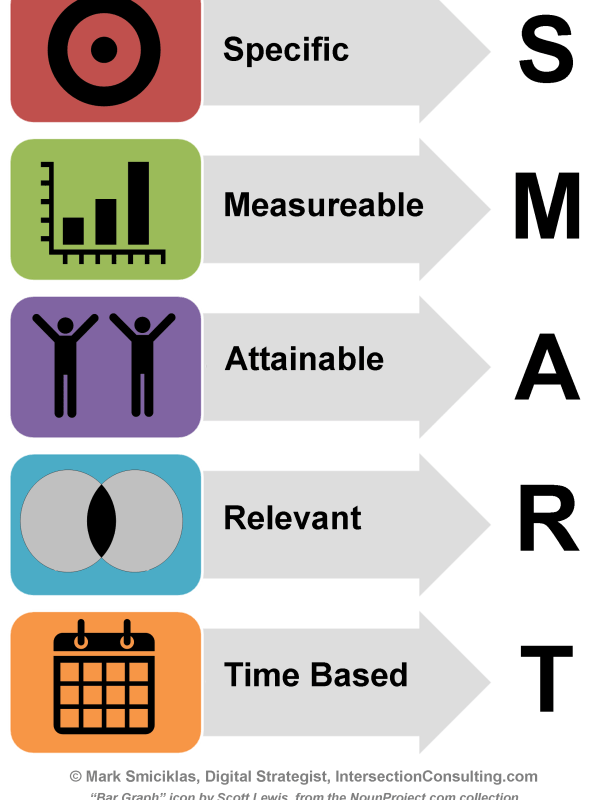
The acrostic SMART is a tool that many have used to help them reach their goals.

Specific

“I want to eat healthier.” “I want to exercise more.” These are not specific goals!  Vagueness is the enemy of progress. It has been said…

“If you aim at nothing you will hit it every time.”

Measurable

Having a measure will let you know if you actually achieved your goal. A measurable goal for eating would be to not eat dessert. A measurable goal for exercise would be 20 minutes twice a week. You know if you did it or not.

A goal without a way of measuring it will not produce the results you want.

Attainable

If you make your goals too big you will ultimately fail and get discouraged. Nothing stops positive momentum more than unattainable and unrealistic goals.

Set a goal that stretches you but also is something you can actually picture doing. This is why many diets don’t work. People don’t build goals with the fact that life is unpredictable into their system. The result is they fall of the wagon and they fall hard!

An attainable goal is a goal that can fit into your life now with out totally rearranging your schedual!

Relevant

Don’t set goals about things that don’t fit with your primary mission.  What we say no to impacts us just as much as what we say yes to. Part of keeping the goals that are important to us is learning to say no to good things so that we can say yes to the best things.

Time-Based

Time is your best friend in goal setting. If you set a goal for a limited time you will be able to look back and see your progress. For example, last year I set a goal of blogging everyday through the New Testament. When I was finished with the year I knew I was finished with my goal!

What are some of your goals for 2015?

Please answer the question in the comment section or share this post on Facebook or Twitter. Also you can sign up for my email list on the top of the blog to get posts sent directly to your inbox.

Don’t Mess With God’s Word – Revelation 22

At the end of the Revelation there is a strong warning not to add or subtract from it.

“And I solemnly declare to everyone who hears the words of prophecy written in this book: If anyone adds anything to what is written here, God will add to that person the plagues described in this book.  And if anyone removes any of the words from this book of prophecy, God will remove that person’s share in the tree of life and in the holy city that are described in this book.” Rev 22:18-19

Even though this warning is specifically for the book of Revelation I believe the principle of not adding to or taking away from the Bible stands for all 66 books.

When we add extra rules to the Bible we become legalistic.

Paul warned the Corthians not to go beyond what is written because this leads to pride.

“That you may learn by us not to go beyond what is written, that none of you may be puffed up in favor of one against another. I Cor. 4:6b.

Make sure you do not make helpful tools for you into rules that everyone should do.

When we take the parts of the Bible away that make us uncomfortable, we miss vital truth and water down the gospel.

Our culture would like Christians to adapt our message, but we must not. The power of our message only holds strong when we stick to the truth.

In an attempt to win them over we confuse true seekers if we don’t address the hard parts of the Bible. When they do eventually hear the truth they will wonder why we were not more straight forward.

The great thing about God’s Word is that it tells us everything we need to know to follow him and live productive lives.

What are some other reasons that it is important not to add or subtract from the Bible?

Share on Facebook or Twitter or post a comment. Get daily updates by subscribing by email. From my reading in Revelation 22 in the One Year Bible New Testament.